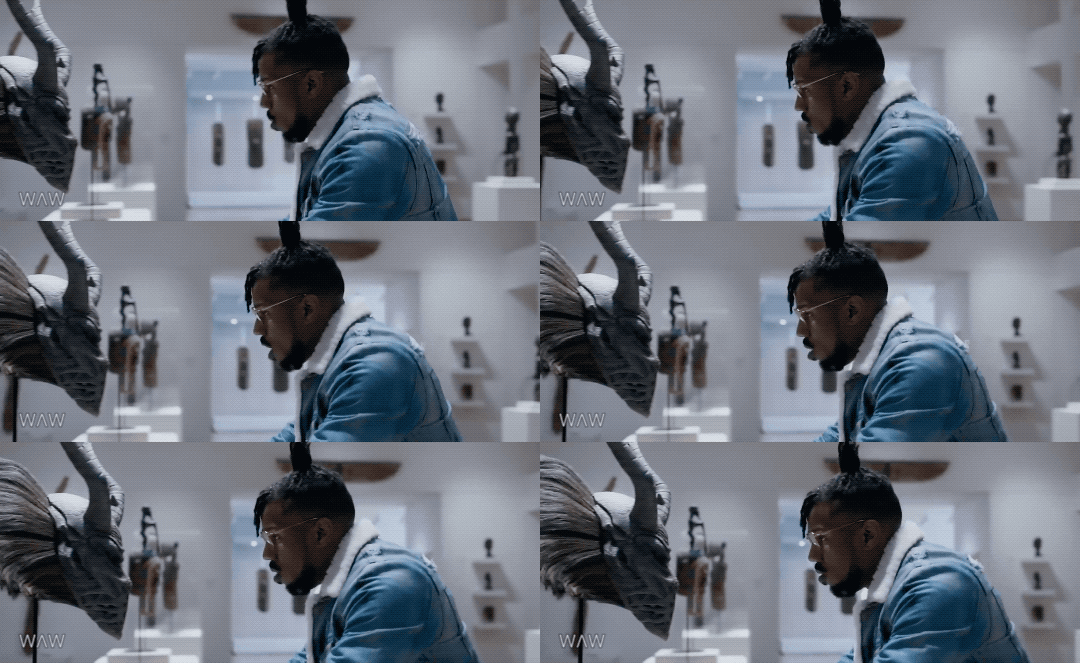
Killmonger: How do you think your ancestors got these? You think they paid a full price for it? Or did they take them like they took everything else?
I work in a museum- an old one- and during this scene I was nudging my brother the whole time. I clapped a little at that line. Museums need to rethink the way we curate things. If we aren’t elevating the heritage of those objects’ creators, if we aren’t telling their story, if we aren’t making those narratives accessible to the descendants and letting them lead, then what is even the point? Decolonize collections. Practice co-curation. Hire scholars of color, and make the collections accessible to visiting scholars. Involve the descendant community and elevate their voices, not the white colonial narrative.
And for goodness’ sakes, don’t run your museum like a jewellery shop. Have context. Honor the objects for their beauty, but remember that no object is as important as the people who created it.
Ummmm,, and like straight up, give things back? Indigenous communities in North America have campaigned for decades to have body parts, ceremonial items and sacred parts of our history returned to their communities.
Ofcourse, Hurd scholars of colour and think critically about your role. But like sometimes, you just have to give things back.
That’s repatriation (what I meant by “decolonize collections”) and it’s actually been federal law in America for almost thirty years. It’s been happening and will continue to happen, but it’s a LOT more complicated than just “give the stuff back.” Obviously you’re totally right- giving the stuff back is absolutely necessary.
But at the same time, giving ALL the old stuff back to Native groups doesn’t really work, either- for us OR for them. What happens to the stuff when it goes back? Do the modern Alaskan Athabascans really want the 1000+ baskets the museum I work at holds? (No, they don’t. We asked them. They definitely do not want those baskets back.) What about Native groups who don’t want remains back- the Navajo, for instance, believe that the remains of the dead are taboo objects, unclean and best left buried. And there are some Native groups who actually WANT their objects in museums. Not every object has a ritual context- sometimes a pot is just a pot. Even some ritual objects aren’t as spiritually important, and we’ve actually had people from different tribes come in and help rewrite language surrounding an object, or give instructions as to how it should be stored. Some groups really want us to display their cultural artifacts, because it reminds people that Native American cultures are alive and real.
One thing that works really well in a lot of cases is co-curation, which is when we commission and work with Native artists, leaders, and scholars to reframe the way we display objects. Like, recently, we asked Chris Pappan, who’s a Kanza artist, to come in and draw on the displays from the ‘30s. The juxtaposition of his art with the colonialist view of Native Americans has had a huge impact in visitor impressions- people go to that gallery now to learn and see what’s ACTUALLY happening today with Native Americans. This I think is how these institutions can use their power for good- elevating creator voices and letting them present their own past and own history. The Field does that a lot- we’ve had exhibitions from Rhonda Holy Bear, Bunky Echo-Hawk, and are continuing to work with Native Americans from many tribes to redesign and reframe the objects on display. We’re not doing this for social justice points- we’re doing this because the Field Museum gets something like 1.5+million visitors a year, and we owe it to the Native tribes we stole from to a.) tell their story b.) how they want it.
If you take all evidence of Native Americans out of the big natural history museums, you’re taking away representation- and education- and a lot of tribes actually don’t want that. What many groups want is the old colonial narratives to go away and be replaced with their own messaging and history. Native Americans are mythologized and what we did to them is sanitized in the US education system. I know that the person who responded is in Canada- and from what I hear, they’re even worse about destroying Native history and sanitizing what the colonists did (and continue to do) to them and their cultures. And this is where I think museums can actually HELP. People only care about things they’re familiar with. If the only image you have of a Native American is a racist football mascot, you’re not going to care about them as a culture- you’re not even going to see them as people. There’s a lot of white people who don’t believe in Native Americans. Like, they legit don’t think that there’s ANY Native groups left, and I know this because I’ve talked to these people at work. It’s baffling, how little Americans know about their own country’s behavior. And it’s totally a global problem- I could go on for days about what the British Museum Needs To Do With Those Fucking Marbles, Give Them Back You Cowards, You Have Enough Money To Ensure Their Care In Greece You’re Just Being Assholes- but I wanted to respond with a Native American context because of the person I’m replying to AND because… well, most Americans don’t know this, and they need to, because knowing about repatriation and why we do it is important.
Repatriation is so very vital, but it’s even more vital to listen to the Native American groups and ask them what they want to happen- as well as treat each tribe individually. We don’t hold onto Tlingit remains because the Navajo don’t want their remains back. Treating all tribes as identical is wrong- not as wrong as withholding their precious cultural traditions, relics, and remains- but if we’re even going to (as a museum industry) attempt to apologize for the atrocities we’ve sanctioned, the first thing we gotta do is ask people what they want.
And the next thing we gotta do is listen.
I’m starting to work in a Museum, and though my museum is about Natural Science something stuck le about all of this. The museum does not only exhibit but also safekeeps collections and in the introductory course we were given three keys to the basis of a museum: preservating, researching and exhibiting.
And one is worthless without the other. Our collections are meaningless if they aren’t available for investigation. It’s totally encouraged for scientists to come and use our collections. Granted, our collection mostly consists of dead animals, plants and fossils. And part of my own museum’s goal is orientated to reclaiming by mostly having our own collections as otherwise some of our best fossils are exhibited in museums in USA.
In our museum, all a scientists has to do is basically send an email to access the collection.
So what strikes me is that you point that one of the things to get better is “make the collections available to visiting scholars”. Is that not the case? Or is it specifically not available to scholars of color?
It REALLY varies from museum to museum! Some museums it’s really easy to get in- but others, it’s SO. MUCH. RED. TAPE. I had mine in mind when I was writing that, because collections access takes absolutely forever.
As an archaeologist, I really appreciate the above commentary. The current generation of archaeologists, historians, and other scholarly professionals- we know this is a big issue with what we do, and how we do it. For the most part, we’re earnestly trying to repair the damage as best we can and find ways to respectfully learn and educate about history and culture while building positive relationships with the people actually in these cultures. But, this has been happening for a long time; the damage runs deep and a lot of problematic things have been institutionalized. So, it’s baby steps, with a lot of caution on all sides of the equation.
Also on the topic of “the Native groups might not want the things back”, most artifacts at museums have gone through some treatment processes to clean/protect/preserve them. Sometimes this involves putting literal poisons on them, as a protection against bugs and other parasites, before the items can be stored near the rest of the collections. And yeah, when you’re talking about objects that have important cultural meaning or are even sacred, and were taken without permission to begin with, that’s super cringe-y, but again, a lot of this was done decades ago before there were better protections in place (not an excuse but, well, we can’t un-poison it now). So yeah, groups might not want those back because they are physically and/or ritually poisoned and dangerous.
Meh, past right of conquest has to mean something. Sure, the museum are the owners, and they can give things back if they want, but as a general return policy, disagree.
The fact that you’re using past right of conquest instead of the very valid scientific and historical concerns is… interesting. And also indicative that maybe you didn’t read the discussion. It’s not a general return policy, it’s an active consideration of global descent communities and creating opportunities to reach out and acknowledge the past damages that this conquest caused. It’s creating a picture of global heritage, not a trophy case. Not every artifact should go back, and nobody is saying that. It’s just a call for improving museum policy in a way that honestly makes museums better for everyone.

 Exodus from the blue hellsite