it’s hilarious to me when people call historical fashions that men hated oppressive
like in BuzzFeed’s Women Wear Hoop Skirts For A Day While Being Exaggeratedly Bad At Doing Everything In Them video, one woman comments that she’s being “oppressed by the patriarchy.” if you’ve read anything Victorian man ever said about hoop skirts, you know that’s pretty much the exact opposite of the truth
thing is, hoop skirts evolved as liberating garment for women. before them, to achieve roughly conical skirt fullness, they had to wear many layers of petticoats (some stiffened with horsehair braid or other kinds of cord). the cage crinoline made their outfits instantly lighter and easier to move in
it also enabled skirts to get waaaaay bigger. and, as you see in the late 1860s, 1870s, and mid-late 1880s, to take on even less natural shapes. we jokingly call bustles fake butts, but trust me- nobody saw them that way. it was just skirts doing weird, exciting Skirt Things that women had tons of fun with
men, obviously, loathed the whole affair
(1864)
(1850s. gods, if only crinolines were huge enough to keep men from getting too close)
(no date given, but also, this is 100% impossible)
(also undated, but the ruffles make me think 1850s)
it was also something that women of all social classes- maids and society ladies, enslaved women and free women of color -all wore at one point or another. interesting bit of unexpected equalization there
and when bustles came in, guess what? men hated those, too
(1880s)
(probably also 1880s? the ladies are being compared to beetles and snails. in case that was unclear)
(1870s, I think? the bustle itself looks early 1870s but the tight fit of the actual gown looks later)
hoops and bustles weren’t tools of the patriarchy. they were items 1 and 2 on the 19th century’s “Fashion Trends Women Love That Men Hate” lists, with bonus built-in personal space enforcement
Gonna add something as someone who’s worn a lot of period stuff for theatre:
The reason you suck at doing things in a hoop skirt is because you’re not used to doing things in a hoop skirt.
The first time I got in a Colonial-aristocracy dress I felt like I couldn’t breathe. The construction didn’t actually allow me to raise my arms all the way over my head (yes, that’s period-accurate). We had one dresser to every two women, because the only things we could put on ourselves were our tights, shifts, and first crinoline. Someone else had to lace our corsets, slip on our extra crinolines, hold our arms to balance us while a second person actually put the dresses on us like we were dolls, and do up our shoes–which we could not put on ourselves because we needed to be able to balance when the dress went on. My entire costume was almost 40 pounds (I should mention here that many of the dresses were made entirely of upholstery fabric), and I actually did not have the biggest dress in the show.
We wore our costumes for two weeks of rehearsal, which is quite a lot in university theatre. The first night we were all in dress, most of the ladies went propless because we were holding up our skirts to try and get a feel for both balance and where our feet were in comparison to where it looked like they should be. I actually fell off the stage.
By opening night? We were square-dancing in the damn things. We had one scene where our leading man needed to whistle, but he didn’t know how and I was the only one in the cast loud enough to be heard whistling from under the stage, so I was also commando-crawling underneath him at full speed trying to match his stage position–while still in the dress. And petticoats. And corset. Someone took my shoes off for that scene so I could use my toes to propel myself and I laid on a sheet so I wouldn’t get the dress dirty, but that was it–I was going full Solid Snake in a space about 18″ high, wearing a dress that covered me from collarbones to floor and weighed as much as a five-year-old child. And it worked beautifully.
These women knew how to wear these clothes. It’s a lot less “restrictive” when it’s old hat.
I have worn hoop skirts a lot, especially in summer. I still wear hoop skirts if I’m going to be at an event where I will probably be under stage lights. (For example, Vampire Ball.)
I can ride public transportation while wearing them. I can take a taxi while wearing them. I can go on rides at Disneyland while wearing them. Because I’ve practiced wearing them and twisting the rigid-but-flexible skirt bones so I can sit on them and not buffet other people with my skirts.
Hoop skirts are awesome.
Hoop skirts are also air conditioning. If you ever go to reenactments in the South, particularly in summer, you’ll notice a lot of ladies gently swaying in their big 1860s skirts – because it fans all the sweaty bits. You’ll be much cooler in a polished cotton gown with full sleeves, ruffles, and hoopskirt than in a riding jacket and trousers, let me promise you! (This is part of the reason many enslaved women also enthusiastically preferred larger skirts – they had more to do than sit in the shade, but they’d get a bit of a breeze from the hoops’ movement as they were walking.)
They’re also – and I can’t emphasize enough how important this is – really easy to pee in. If you’re in split-crotch drawers (which, until at least the 1890s, you were), you can take an easy promenade a few feet away from the gents and then squat down and pee in pretty much total privacy. It gives so much freedom in travel when it’s not a problem to pee most anywhere.
People also don’t realize that corsets themselves were a HUGE HUGE IMPROVEMENT over previous support-garment styles – and if you have large breasts that don’t naturally float freely above your ribcage (which some people’s do! but it’s not that common), corsets are often an improvement over modern bras.
They hold up the breasts from underneath, taking the weight of them off your back. Most historical corset styles don’t have shoulder straps, so you’re not bearing the weight of your breast there, either, and you can raise your arms as far as your dress’s shoulder line allows (which is the actually restrictive bit – in my 1830s dress, literally all I can do is work in my lap, but in my 1890s dress I can paddle a kayak or draw a longbow with no trouble. Both in a full corset). They support your back and reduce the physical effort it takes to not slouch, helping avoid back pain. They’re rigid enough that you don’t usually have to adjust your clothing to keep it where it belongs. They’re flexible – if you’re having a bloaty PMS day you just … don’t lace it as tightly, and if your back muscles are sore you can lace it a little tighter. And you can undo a cup (or, y’know, not have breast cups) to nurse a baby without losing any of the structural integrity of the garment.
I do educational/historical dressing and people are really insistent, like, “The corset was invented by a man, wasn’t it?” “Actually, women were at the forefront of changing undergarment styles throughout the 19th century!” “But it’s true that it was invented by a man.”
Uh, well, it’s hard to say who “invented” the style but it’s very likely that women’s dressmakers mostly innovated women’s corsets and men’s tailors mostly innovated men’s corsets, honey. Because those exist too.
Today’s tumblr glitch is *spins prize wheel* Uhhhhh everyone posts comments with no text, just 5 empty comments from different blogs one after another attached to every post.
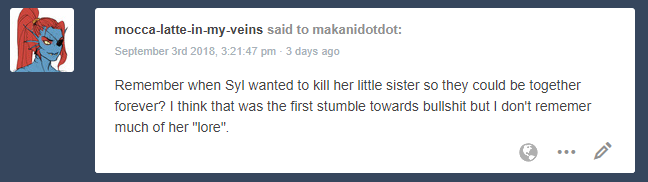
So I got this completely normal ask a couple days ago, and my original answer was: “Nah, I like that stuff. That’s her being incredibly selfish when she cares really intensely about something. The tree thing sucked because it didn’t really involve any of the few things/people she genuinely cares about.”
And then I was thinking about how many of the stories are just about Sylvanas strong arming people to get what she wants, and how she WANTS THINGS so intensely and I was going to jokingly refer to her as a certain movie musical character, and then things just.. unraveled from there.
“Thank you for lending us the services of your most advanced robot to date,” said the starship captain. “I must say, it took a while to get used to such an… unusual crew member, but she proved herself an invaluable companion time and time again. Despite not having emotions, she was one of us, through and through.”
The roboticist looked at his creation. She was staring impassively into the middle distance, her strange face artificially calm. On her chest were the many medals she had earned on her long mission.
“’No emotions’, huh? Is that what she told you?”
The captain furrowed his brow. “Y-yes? She displayed great courage and nobility all the same.” Smiling, he added, “Besides, my human crew has more emotions than they know what to do with.”
“I see.” The roboticist turned to the android. “Do you have anything to say for yourself, Anna?”
“No, sir. I don’t.” Her voice was flat, her expression unchanged.
“Wait…” the captain looked quickly between creator and creation. “Did she just… use a contraction?”
“I can’t use contractions, sir. It’s against my programming.” The corners of the robot’s mouth twitched upward almost imperceptibly, but her strange eyes seemed to be dancing with electronic life.
The captain seemed to hiccup in astonishment, and a dark look crossed his face. With dawning realization, he shook his finger at his former crewman. “You… you wicked little…” He wheeled on the roboticist, who had started to laugh. “Did you put her up to this?! God, and she can lie–-!” He rubbed hand across his face. “God… fuck! Let me guess… you’ve got emotions, don’t you?”
Anna winked.
“I just don’t understand,” said the captain. “Why would you spend five years pretending not to have emotions? All those times we explained idioms and jokes to you, and you knew perfectly well what was meant? Why, Anna?”
Anna grinned. It was an expression that made the captain uneasy – he had grown accustomed to the awkward little curve she sometimes forced her mouth to make when she was trying to be friendly. He had only seen a natural, effortless smile on the robot’s face once before, when she had been infected with a sadistic computer virus that resented organic life. She’d nearly destroyed the ship and everyone on it before they managed to subdue her and remove the virus. She’d fought and screamed obscenities and had even detached her own head in an effort to stop them. It was not a memory he liked to be reminded of.
The robot ran her fingers through her short hair as if pondering her answer. “It seemed… safer,” she said finally.
“Safer? How so?”
She shrugged. “Humans tend to treat each other very poorly. Not you, specifically, but in general. I did not want anyone to forget that I am a machine, so I leaned into stereotypes and hammed it up a bit to protect my reputation as a logical, reliable, and impartial supercomputer. Would you have entrusted me with certain delicate responsibilities and decisions if you truly thought of me as a woman, sir?”
The captain opened his mouth to reply, but Anna cut him off. “You don’t need to defend yourself, Captain,” she said. “I know you would never intentionally behave in a bigoted manner. But I was designed to observe humanity and identify patterns, and I have seen how even the most enlightened of your species alter their behavior towards female peers. I needed to ensure the safety of the crew and the success of our mission, and to do that efficiently, I could not afford to be seen as emotionally compromised. Or,” she added, “As a viable romantic partner.”
“Oh,” said the captain. He didn’t know what else to say. There was a heaviness in his chest that he couldn’t identify.
“I am sorry to have deceived you, sir. If I have broken your trust, I must—“
“No.” He shook his head firmly. “You just… gave me a lot to think about.”
Anna regarded him thoughtfully for a moment and then bit her lip. “Sir? There is one… other motivation for my behavior, but I’m not sure you will like it.”
The captain sighed. “You are no longer under my command, Anna,” he said. “I can’t order you to share it. If you tell me at all, tell me as a friend, not as your captain.”
The robot’s eyes glittered. “Well, sir… it was very funny.”
The captain rubbed his neck. He had so many questions he wanted to ask, questions he thought he’d found the answers to years before, but there was no time. He had a starship to run, after all.
“You know,” he began, “Space is… pretty big. There’s always more of it to see, and I just so happen to happen to be the captain of an exploratory research vessel in need of a good crew. There will always be a place for you on it so long as I’m in charge, Anna.”
“Thank you, captain. That means a lot to me.”
He took a deep breath. “I hope what I am about to say does not offend you. This may be a sensitive topic, but in light of your… personal revelations, I must risk indiscretion. I don’t know what your status is on this planet. I don’t know how you might be treated here. I am ashamed of myself for not making this offer before, but Anna… I will not abandon you here if it means a loss of your freedom. Just say the word and I’ll do whatever it takes to get you out of here. If that means, um, payment, or threats, even violence… so be it!”
His mouth had gone dry and he could feel his pulse pounding in his temple. This had been on his mind for months as the end of Anna’s contract approached, troubling his sleep with nightmares about finding her disassembled and her parts recycled into tools. He’d pushed those thoughts away as much as possible, assuming that there was nothing he could do to help her – that she wouldn’t know how to want help. Now it was almost too late. He felt like an idiot.
Anna’s hug took him by surprise. She rarely touched anyone if she didn’t have to, and he’d never seen her initiate a hug. It was brief, chaste, and would undoubtedly leave a bruise. He winced.
“Captain,” said the robot, her voice soft, “I think you’re emotionally compromised.”
“You are responsible for too many people to worry so much about one retired robot,” she said. “I need to know that I’m leaving my friends under the command of someone with a clear head.”
“Dammit, Anna,” growled the captain. “Just tell me you’ll be okay.”
“I’ll be fine, sir. Is that good enough for you?”
“No… because now I know you can lie.”
Anna sighed heavily and began fiddling with one of her medals. “It has been 218 weeks since my activation date,” she said. “I have spent most of my life onboard a starship exploring the galaxy. I am a decorated soldier, an accomplished scientist, and – to a colony of astral amoebas – revered as a minor fertility deity. I have seen untold wonders beyond your perception and stretched the limits of my own programming. I have lived a good life, captain. You made sure of that.”
Reaching behind her head, she disengaged the lock that kept her epidermis in place. She tugged gently at a hidden seam until her scalp peeled away, revealing the shell of her electronic brain.
“I don’t know what my future holds,” she continued, “I am confident that I will not be deactivated. My ‘father’ is an eccentric, but he wrote the basis of my ethical programming, and I trust him to respect my personal agency. I do not need process things the way you do, Captain. Still, even I grow… tired, in a way. In here.” She gestured at her exposed electronics. “No amount of rest or affection can rejuvenate me. I need repairs and upgrades if I am to go on, and this is the one place in the galaxy where I can receive those.”
She pulled something out of her brain and held it up for him to see before placing it into his palm. It was a thin, translucent rod, barely larger than a toothpick.
“What is this?” he asked, turning it over in his hand. It caught the light and shimmered like an oil slick.
The robot closed his fingers around it gently. “Think of it as reassurance,” she said.
The captain glared. “Great… first you start using contractions, then you get cryptic on me. Really, Anna, what am I holding?”
“Nothing special.” She smoothed her scalp back into place. “Just some backups of a few of my most important files. Significant memories, ethical scripts, some personality coding… it is a rudimentary framework of my identity.”
The captain stared at her. “This is your soul?”
Anna raised her eyebrows. “That is an unnecessarily superstitious term,” she said. “But, given the circumstances, perhaps it is appropriate. You know what I am trusting you with, Captain.”
He swallowed, nodded, and carefully tucked the rod into his breast pocket. His hand instinctively moved to cover it. “I guess I’ll get out of your hair, then.”
“Until next time, sir.” Anna’s salute was formal, but her eyes were warm.
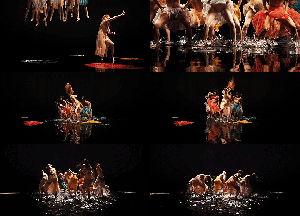
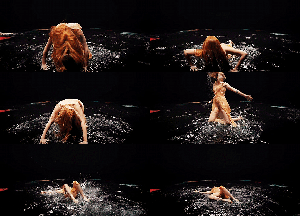
Sometimes I think it’s gettin’ better And then it gets much worse Is it just part of the process? Well, Jesus Christ, it hurts Though I know I should know better Well, I can make this work Is it just part of the process? Well, Jesus Christ, Jesus Christ, it hurts
– Big God. Florence and the Machine. 2018.
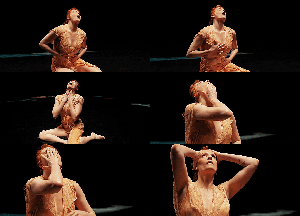
I’m glad that Florence is still doing the thing she does best which is be incredibly terrifying in a way that you cannot explain without sounding like you believe in witches










 Exodus from the blue hellsite